

Roman Tavast’s suitcase
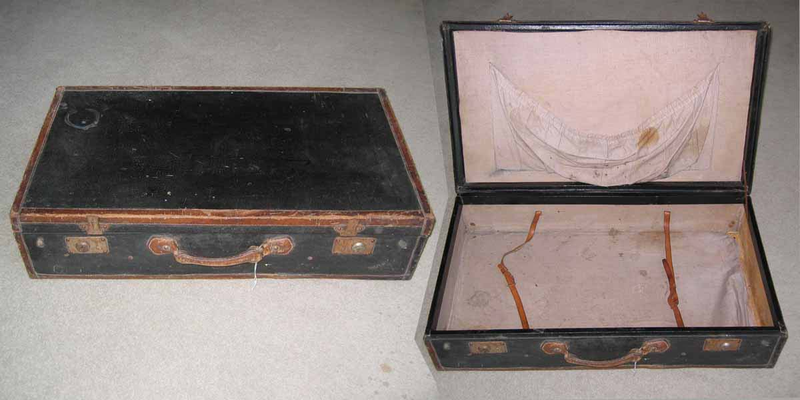
On 14 June 1941, Soviet authorities arrived at the Tavast family home at dawn. “The deporters arrived around seven in the morning, knocking over milk bottles the milkman had left on the steps,” recalled his son, Raul-Roman Tavast in his handwritten memoir. The family had only minutes to pack, Roman’s wife managed to prepare three suitcases for four people. That morning was the last time Roman Tavast saw his wife and children. He was deported to the Sosva settlement in Sverdlovsk Oblast, where on 3 August 1942, he was executed. Years later, the largest black suitcase with leather corners and a smaller brown leather one made their way back to Estonia. Today, they stand in Vabamu as silent witnesses to displacement and endurance.
Voldemar Tammemägi’s emigrant trunk
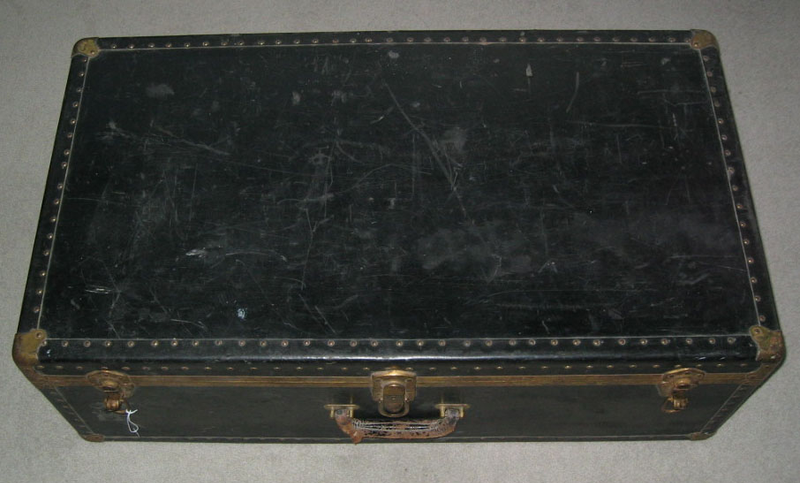
This wooden, tin-plated trunk with metal handles belonged to Dr. Voldemar Tammemägi (1913–1989), a recognized physician in the Estonian-Canadian community. Voldemar graduated from the University of Tartu shortly after World War II and served as a German military doctor in Tartu. When Soviet forces returned in 1944, he and his wife Eha fled Estonia. Their first son, Ants (Hans), was born that autumn; later, two more sons, Martin and Peeter, were born. In 1948, the family moved from Sweden to Canada, bringing this trunk with them. Inside, it is lined with patterned wallpaper, now worn and water-damaged, a fragile reminder of a long journey and a new beginning.
Lydia Puusta’s suitcase
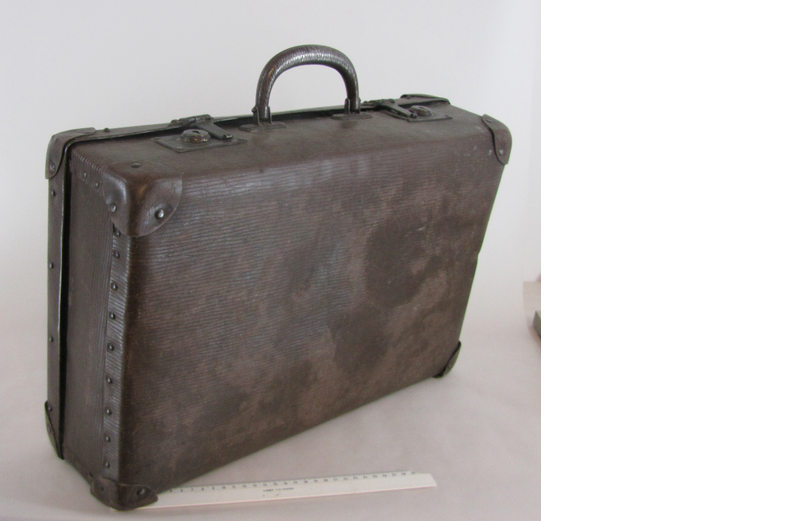
This cardboard suitcase travelled with Lydia Puusta to Siberia and back. Later, photographs from magazines were glued inside, creating a personal keepsake. Lydia’s family had avoided the first wave of deportations in 1941 when the authorities stopped in Rakvere and started drinking instead of collecting families. In March 1949, Lydia and her father Leonhard Puusta were deported from Rakvere to Krasnoyarsk Krai. In Siberia, Lydia and Leonhard were separated; they returned to Estonia in 1956. Lydia, already a strong-willed individual in the 1940s, faced the years of exile with courage. She mocked the occupiers, openly, despised the Soviet regime and Stalin, and longed for the Republic of Estonia. Lydia’s suitcase, now in Vabamu, carries the traces of survival, hope and her unbroken spirit.
These three suitcases remind us that sometimes a whole life must fit into a single bag. They speak of forced journeys, hope against despair, and the resilience of the human spirit, stories that resonate far beyond Estonia.