Back
Back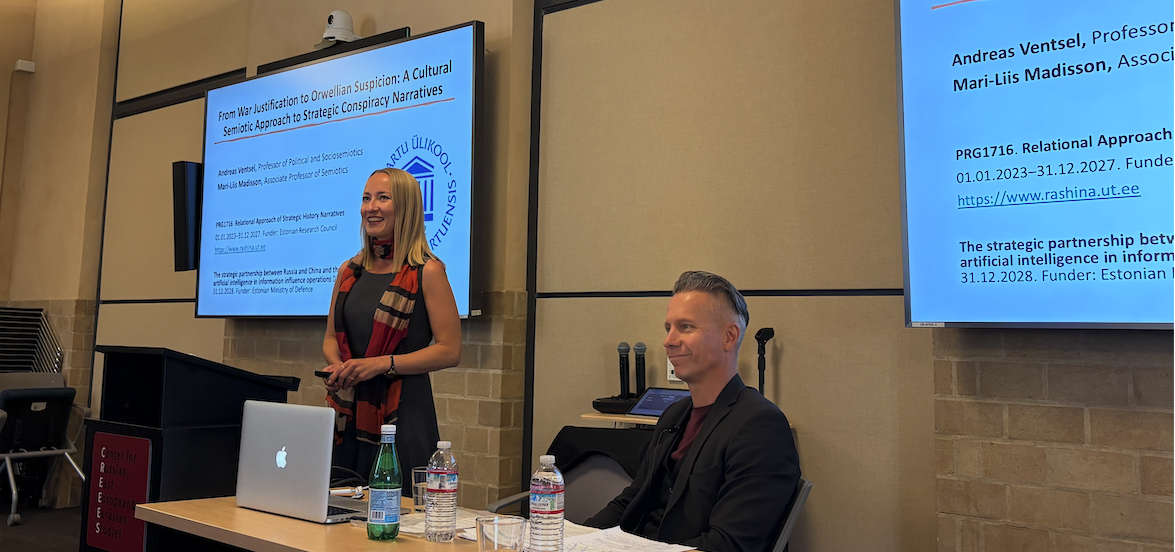
Mari-Liis Madisson:
My two months as a visiting fellow at Stanford University in March and April 2026 coincided with an unusually cold winter back home in Tartu. The Emajõgi river had frozen over for the first time in over fifteen years, thick enough to walk on. Against that backdrop, arriving in California felt like stepping into another season entirely. The warmth and bright sunshine were the first things I noticed, and my four-year-old daughter, who joined me on this adventure, shared my enthusiasm wholeheartedly. She was equally won over by the land of opportunities, particularly its remarkable playgrounds.
Warmth also captures something essential about how I was received at Stanford. I found myself welcomed not only into seminars and lectures but also into meditation groups, campus exhibitions, and concerts. A highlight was an invitation to Sylvia and Andy Thompson’s picturesque home in Portola Valley. The Thompsons sponsor the Baltic visiting scholar programme, and their gathering brought together researchers and students with a shared interest in the Baltic region. It was one of those evenings that reminds you why academic life, at its best, extends well beyond the office.
It was something of a revelation to encounter several American scholars with deep personal ties to Estonia. Bert Patenaude, a Hoover Institution historian of the Soviet era, first visited Tartu in the early 1980s and has followed the region ever since. Alexandra Sukalo has recently been working in Estonian archives and knows more about Sillamäe than I do. Both are a reminder that Estonia has long attracted serious scholarly attention from unexpected quarters. I also had the privilege of hearing Renee DiResta and Larry Diamond speak about their most recent work, and left both talks with new questions I am still turning over.
No less memorable were the encounters with fellow Baltic scholars and practitioners. Maarja Merivoo-Parro, Merle Maigre, Gabrielius Landsbergis, and Vytautas Kuokštis were among those I met, and it was genuinely stirring to see how effectively they are putting the Baltic states on the map, making the case for supporting Ukraine with clarity and conviction.
The proximity between academia and Silicon Valley was perhaps expected, but no less instructive for it. I came away with a much richer appreciation for how many different models American researchers apply when thinking through the social, economic, and cultural implications of AI tools, and how varied the approaches to their practical use can be.
I also had the opportunity to present my recent research on conspiracy theories circulating in Estonia and Latvia and their role in Russian propaganda. The questions from Stanford students and staff were sharp enough to stay with me for weeks afterward, and may yet lead somewhere new. During the fellowship I also completed a manuscript on the securitization of disinformation and gathered thoughts for a possible monograph. Writing it, I am motivated in part by the hope of returning to Stanford one day to present it.
Andreas Ventsel:
My two-month research visit to Stanford University was an extremely valuable and inspiring experience, both intellectually and professionally. The main purpose of the visit was not only to share my ongoing research ideas, but even more importantly to gather new perspectives for formulating my emerging research focus. In particular, the visit helped me to further develop a promising research direction that approaches the concepts of deterrence and coercion from a cultural-theoretical perspective, especially through semiotics and memory studies.
The initial ideas formulated during the visit explore how future threats become imaginable, affectively recognisable, and politically actionable through two security-political operations: securitization and coercion. While securitization makes projected threats publicly urgent and legitimate, coercion makes strategic pressure, deterrence, and compellence thinkable and justifiable. These ideas shift the analysis of security politics from the governance of existing threats to the cultural pre-production of future threats, asking how societies come to recognise, fear, and authorize action against dangers that have not yet occurred.
Together with Mari-Liis Madisson, I also gave a lecture titled “From War Justification to Orwellian Suspicion: A Cultural Semiotic Approach to Strategic Conspiracy Narratives.” The talk examined the strategic use of conspiracy narratives through the lens of cultural semiotics. Focusing on two different cases, I analysed how the Kremlin mobilises conspiracy narratives to justify the war against Ukraine. Rather than treating conspiracy narratives merely as false claims or irrational beliefs, we approached them as culturally resonant meaning-making devices that organise fear, moral antagonism, and political identification. I showed how such narratives gain persuasive force by attaching themselves to collective memory and by activating familiar interpretive frameworks rooted in historical experience. In the Kremlin case, this includes mnemonic links to antifascist war mythology and imperial conceptions of historical unity.
A particularly rewarding part of the visit was the opportunity to meet and exchange ideas with other fellows at the Center for Russian, East European and Eurasian Studies, as well as with colleagues from Stanford University, including Bert Patenaude, Anna Grzymala-Busse, Christophe Crombez, and Amir Wierer, to name just a few. These conversations were highly stimulating and opened up several possibilities for future collaboration. With some colleagues, we discussed concrete opportunities for continued academic exchange, and it may be possible to host several of them at the University of Tartu in the near future.