

 Back
Back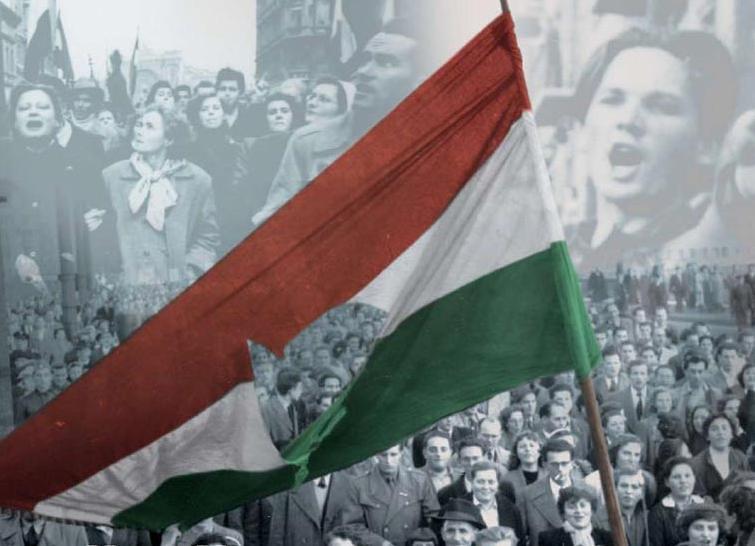


To mark the 70th anniversary of the Hungarian Revolution and Freedom Struggle, renowned Hungarian jazz guitarist István Gyárfás and his ensemble Guitar Madness will perform in Tallinn in Vabamu on October 23. The musicians will present a programme of jazz pieces inspired by the events of 1956.
Guitar Madness:
István Gyárfás – guitar
Attila Rieger – guitar
Gábor Szalay – guitar
Márton Soós – double bass
Balázs Cseh – drums
In the summer of 1956, Ernest Nagy, an employee of the American Embassy in Budapest, secretly recorded works by several Hungarian jazz musicians in a studio. These recordings were later smuggled to the United States and reached Willis Conover, host of the Voice of America radio station.
On October 23, 1956, a revolution erupted in Hungary against the communist regime, which Soviet forces ultimately drowned in blood. On November 23, 1956, Conover played the recordings that had reached him on Voice of America. They were commented on by jazz luminaries of the time—Quincy Jones, Gerry Mulligan, Tony Scott, J.J. Johnson, and Billy Taylor—who did not know if any of the musicians heard on the recordings were still alive. On the 60th anniversary of the revolution, the recordings were played again, this time under the title “Revolutionary Jazz.”
This concert pays tribute to Enn Uibo, Enn Tarto, and all Estonian friends who stood for Hungarian freedom in 1956 and became victims of Soviet repression as a result.
On this 70th anniversary of the revolution, these pieces are brought to the Estonian audience by renowned Hungarian jazz guitarist István Gyárfás and his ensemble Guitar Madness, to commemorate those events and honor the memory of Hungarian and Estonian heroes.
The Hungarian Revolution of 1956 began as a student demonstration that rapidly grew into a mass movement; by evening, there were already 200,000 demonstrators. They marched through downtown Budapest to the Hungarian Parliament building, seized the party headquarters and radio station, and toppled Stalin’s statue. The Soviet emblem was cut out of the Hungarian state flag, leaving a hole in the center of the tricolor. The demonstrators demanded freedom, human rights, and sovereignty. The Communist Party was ousted from power, and several party leaders fled to Moscow.
Security agents, the main adversaries, put up resistance, and there were fatalities among the insurgents. However, public anger was so intense that around a hundred Communist Party workers were either killed or executed summarily. A nationwide uprising broke out, with parts of the Hungarian army defecting to the insurgents’ side. New local governments were formed, steering toward a multi-party system and market economy—measures that terrified the communists. The party leadership began demanding the entry of Soviet troops into Budapest.
On November 4, Soviet tanks rolled into Budapest, sparking fierce battles, but by November 10, the uprising was crushed. Over 700 Soviet soldiers and more than 2,000 Hungarians were killed. In the subsequent repressions, 300 insurgents were executed, and thousands were imprisoned. Over 200,000 Hungarians fled to Austria.
The events in Hungary were closely followed in Estonia as well, influencing the local national movement. As Küllo Arjakas wrote in a newspaper on October 22, 2016, Enn Tarto’s founded Estonian Youth Battalion distributed leaflets in Tartu schools overnight on November 4 in support of the Hungarians.
Tarto recalled: “In mid-November, a propagandist from Moscow, injured and mangling the Estonian language, visited the 3rd Secondary School. Together with the principal, he demanded at a student assembly that Hungarian patriots be condemned. Led by the most active youth, the students responded with a chorus of boos and foot-stamping. This forced the principal and propagandist to leave the hall.”